THE SUBJUNCTIVE MOOD
The subjunctive mood is a special verb form used to express wishes, suggestions, demands, importance, or situations that are not necessarily real. It is commonly used after expressions like I suggest, It is important that, I wish, and If I were. Understanding the subjunctive helps learners speak and write more naturally, formally, and accurately in English.
The Subjunctive Mood
The subjunctive mood is an English verb form that does not express reality but unreal facts, such as wishes or possible events.
There are three moods in English: the indicative mood is for stating facts and opinions like "That cat is fabulous." The imperative mood is for giving orders and instructions (usually with an understood subject, you), as in "Look at that fabulous cat." The subjunctive mood is for expressing wishes, proposals, suggestions, or imagined situations,** as in: "I wish I could look at that fabulous cat all day." *- If it were me, I'd go. (As this explores a hypothetical situation, "was" becomes "were.")
- I wish it were real. (As this expresses a wish, "was" becomes "were.")
- It is imperative that the game begin at once. (As this expresses a demand, "begins" becomes "begin.")
- I propose he work full time. (As this expresses a suggestion, "works" becomes "work.")*
The subjunctive is a reasonably formal expression, which means that it is usually used in written language. Compare some examples: • Although the subjunctive is no longer significantly dominant, it is still an integral part of English grammar. At times, it is not even recognizable, as it corresponds to the form of the indicative (the ‘normal’ form, i.e., realis mood) in many cases. Some fixed phrases, which are well-known, would be, for example:
- “God save the BTC.”
- “God bless you.”
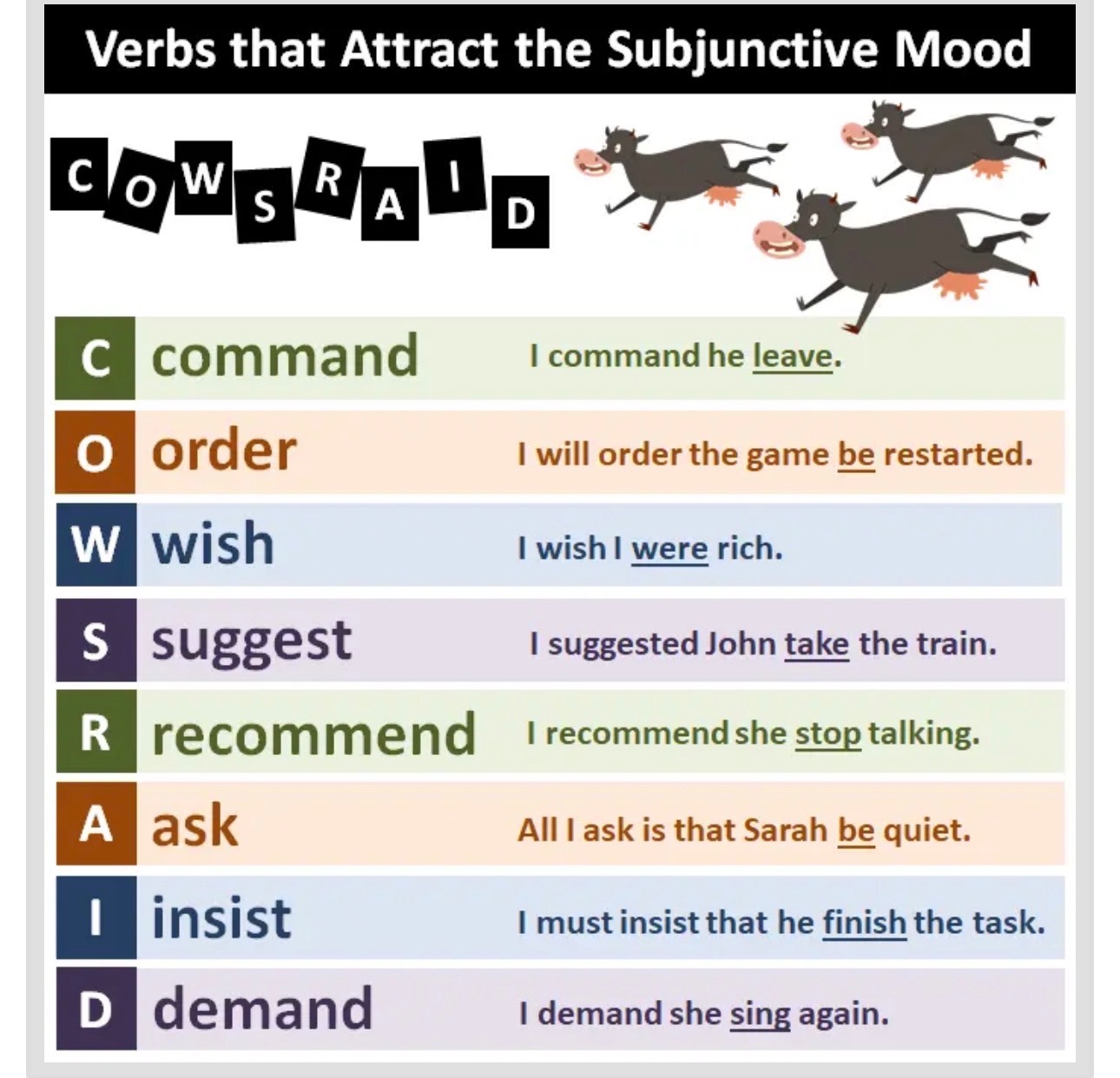
The subjunctive stands if wishes, desires, requests, or things that need to be done are expressed. For this reason, it regularly appears with related verbs such as ‘exist, suggest, demand, advice, propose, recommend, desire’. after such phrases as <u>it is advisable and it is necessary.</u>
- “The headmaster requested Paul come to his office.”
- “Dr Miller recommends that Sally take vitamins every day.”
• Likewise, the subjunctive frequently occurs with specific phrases or expressions such as ‘it is recommended; it is urgent; it is essential; it is crucial; it is a good idea’, etc., as these also express a desire:
- “It is essential that the pilot have enough rest.”
- “It is a good idea Martin wear a life jacket on the boat.”
• 1. Often, it is difficult to determine the subjunctive mood in a sentence at first glance. To make the difference to the indicative clear, read the following examples with the verb ‘to be’:
- “It is important that you be there.”
• Here, the subjunctive is in the present tense, so its verb form in the 2nd person singular is ‘be’. In the indicative of the present tense, ‘are’ would have to be used instead.
- “I wish I were a millionaire.”
• Here, the subjunctive is used in the past tense; in the 1st person singular, it is the form ‘were’. In the indicative of the past tense, ‘was’ would be used instead.
• The subjunctive mood is used in a number of set phrases that tend to be pretty formal sounding: so be it, be that as it may, come what may, suffice it to say, Heaven forbid, and others.
How is the subjunctive formed? Despite the fact that the subjunctive is a remnant verb form in English grammar, it is still quite easy to construct (conjugate). Nevertheless, the formation differentiates between the present tense and past tense forms. Compare: Conjugation in the present tense
• the present subjunctive in truth refers mostly to the future ("I request that the fabulous cat be available during my visit").
• In the present tenses, its form coincides with the infinitive. Mind the appearance in the 3rd person singular in this case, as this form (just like the infinitive) does not get an ‘s’ – in contrast to the indicative forms (rule for ‘he, she, it’):
- “I propose that we study now.”
▪ In this sentence, the subjunctive cannot be identified because both the subjunctive and the indicative forms for the 1st person plural are the same, i.e., ‘study’.
- “I insist that he study now.”
▪ Here, however, it is possible to identify the subjunctive very well because there is no ‘s’ at the end of the verb form ‘study’.
• When using the particular verb ‘to be’, it may at first be somewhat unusual to see or to use the subjunctive form in a sentence. The reason is that this construction may sound grammatically incorrect to many English learners, especially at lower levels (no ‘am, is, are’ is used as in the indicative mood):
- “It is best that we be on time.”
▪ Not: “It is best that we are on time.” Conjugation in the past tense
• The past subjunctive can refer to the present or the past (e.g.,"I wish that the fabulous cat were more cooperative").
• In the past tense, the subjunctive forms do not differ from the regular (i.e., indicative) forms except for the verb ‘to be’. For this verb, only the conjugated form ‘were’ is used (which means no ‘was’ for the 1st and 3rd person singular):
- “If I talked to him about this problem, would he understand?”
▪ ‘talked’ is the same form in the indicative as well as in the subjunctive; thus, no difference can be seen.
- “Jill wishes her vacation were longer.”
▪ In the 1st as well as in the 3rd person singular, ‘were’ must be used here.
References BTC L2 English Grammar